Home

Tuesday, May 8, 2012

Heading East for Easter: Budapest - Sights in "Buda-"

Marisa and I took a pleasant overnight train from Krakow to Budapest, Hungary for the second stop on our trip.  I honestly didn't know much about Budapest, as far as what to see and do, but I'd heard lots of people raving about the place at school.  Of course we were packing Rick Steve's but it's sometimes nice to visit a place with no expectations beforehand.

Budapest has a long history and is sort of the historical boundary between the East and West, as far as Europe's concerned.  The Danube river cuts right through the city, dividing it geographically into the western-side ("Buda") where the Alps end with the Buda Hills and the "Pest" side which is made up of the Great Hungarian Plain which extends into Asia.  The history in a nutshell is that the Roman province of Pannonia once stood on the Buda side until the Roman Empire fell, which led Europe into the Dark Ages.  During this time there were all kinds of dodgy characters running around, including but not limited to: the Celts, Vandals, Huns, and Avars.  Around 896 AD, seven Magyar (MUD-jar) tribes cruised into town and decided to set up shop there and make raids throughout Europe.  They settled in the middle of the Slavic people and made out pretty good until they lost a key Battle of Augsburg in 955 against the Germans and Czechs.  At that point the Hungarian king Geza adopted Christianity and convinced his nomadic people to settle into this area and start thinking long-term. 

Over the centuries the Hungarians held strong against the Tatars and Ottomans, and were ruled by the Habsburgs which put them on the wrong side of WWI.  The Treaty of Trianon in 1920 split up most of the prosperous Hungarian territory into surrounding nations and left them as a prime candidate to support the Nazis with hopes of regaining their land in WWII.  Since that didn't pan out either, Hungary fell under Communist rule and didn't break free until 1989.  Hungary joined the European Union in 2004, but have yet to adopt the euro.  Budapest is a pleasant city at the heart of Hungary and the architecture reflects the diverse background that has brought it to present day.  Check out some pics from the "Buda"-side of the city....

The Chain Bridge crosses the Danube, connecting the "Pest" side (shown) with the "Buda" side.

Legends say that the Magyar tribes were led to this spot by a mythical Turul bird.  The bird dropped a sword down in the Carpathian Basin to let them know that this is where they'd be throwing down.

We happened across an impromptu changing-of-the-guard outside of the Royal Palace.

The former Ministry of War, complete with tons of bullet holes from WWII and from the 1956 Uprising.

View of Matthias Church, named after a famous Hungarian king from the 15th century.

We really liked the mosaic tile-work found on the ceilings on many buildings, such as the Matthias Church.

Although the interior was under heavy renovation, we did get to catch a glimpse of some of the hand-painted walls and ceilings.

View of the Fishermen's Bastion with St. Istvan (Stephen), Hungary's first Christian king (967-1038).  He was baptized by his father, King Geza, and ruthlessly Christianized the nation, beheading those that would not convert.  For that he was credited with keeping Hungary on the map and was sainted after his death.

So that get's us started with Budapest, but the best is yet to come with the sites from the "Pest" side coming up as well as our visit to a Soviet statue park.

--Justin

Friday, May 4, 2012

Heading East for Easter: Krakow, Poland - Old City Sites

Going into our trip to Krakow I had no idea what to expect. Usually going into a trip I have thought about (fantasized about) what I am about to get into but for Poland I had no clue. We have a really good friend in Frankfurt that lived in Poland for 5 years so he gave us a glimpse of what it might be like. Now after having been there, I can say Krakow is a great city. Full of great food, cool vibe, and awesome sights including Auschwitz and the salt mines. The main market square was one of the grandest I have seen. With cafes and restaurants lining the edges and a few churches, a tower, and cloth hall filling the middle. I liked Krakow because it was a city I could take my time and stroll, find a cafe or cupcake shop, and enjoy the moment. I find in a lot of cities I am rushing around to see all the sights instead of just enjoying it. 

The random head in the main market square

St. Mary's Church on the square

The doors of St. Mary's Church

St. Mary's Church and the square at dusk. Amazing right?

The fabulous Cloth Hall from the 14th century. Full of stands selling traditional Polish souvenirs. 

Yes I know this is a lot of pink, I guess I didn't expect it to be so cold when we were there so I had to put on everything I had.


Planty aka the parks surrounding the old town. As you can imagine this would be beautiful in full bloom

The atmospheric streets of Krakow

This was by far my new favorite stain glass piece of all time. Done by the famous 
Polish artist, Stanislaw Wyspianski. This piece is housed in St. Francis' Basilica. Fun fact- this was the church that Pope John Paul II was archbishop of before he became Pope. 

And this was his favorite place to pray. I totally sat in this spot and it was kind of cool.

As you can imagine JP II is well remembered in Poland and this is was his Archbishop Palace.

Replica of a Wyspianski piece. That guy knew what he was doing with some stain glass.

This is Wawel Castle. One thing I want to point out about this castle is all the different styles of architecture that exist in this picture. This is an example of addition after addition throughout the centuries and using the most popular style of that specific time.

You can't go to Poland and not try the Kielbasa sausage. Look at him, he loves it!

Poland's interpretation of a beer hall. I would have to say not bad...

...but instead of beer you get cherry vodka.

A great area to explore was the Jewish Quarter known as Kazimierz

Tons of great buildings like this one and...

lots of very cool bars. If you are ever in Krakow definitely check out this one called Alchemia

The flame-belching dragon of Krakow

Krakow was a great start to our two week trip in Eastern (some consider it Central) Europe and also an awesome place to celebrate 5 years of marriage. Krakow was full of life and history and I feel like I learned so much by going there. By not knowing what to expect going into Krakow it definitely was a pleasant surprise. Coming up next...Budapest!

--Marisa

Saturday, April 21, 2012

Heading East for Easter: Krakow, Poland - Auschwitz Concentration Camp

     I think that everyone should include a concentration camp on their list of places to see in this lifetime. Arguably the most infamous is Auschwitz (OWSH-vits), which lies about 50 miles outside of Krakow in the city of Oswiecim (ohsh-VEENCH-im).  The name of the camp is merely the German version of the Polish city and refers to a system of camps, including: Auschwitz I (with the "Arbeit Macht Frei" gate), and Auschwitz II which is also known as Birkenau (BEER-keh-now) and includes a famous guard tower with train tracks. I've been to other labor camps such as Dachau and Buchenwald, but they are very different from the extermination camps here.
     Auschwitz operated between 1941 and 1945 and was the site of the systematic murder of at least 1.1 million people; mostly Jewish, but also political prisoners, Roma (gypsies), homosexuals, and others deemed impure or harmful to the Nazi regime.  This post is meant to give an idea of the layout of the camps and the atrocities committed there.
"Arbeit macht frei" - Literally "work makes free" was the false promise that greeted prisoners at the gate of Auschwitz I.  The original sign was actually stolen two years ago by some people that wanted to sell it.  It was reclaimed and is now in a museum, so this is actually a replica.  Notice the intact brick buildings that served as the barracks for prisoners.  This camp could hold 14,000 prisoners at one time.

This map in one of the barracks gives a visual of where the prisoners came from in Europe.  At a glance you can see that they came from as far north as Norway, as far west as France I think, as far south as Hungary or Yugoslavia, and as far east as Russia.

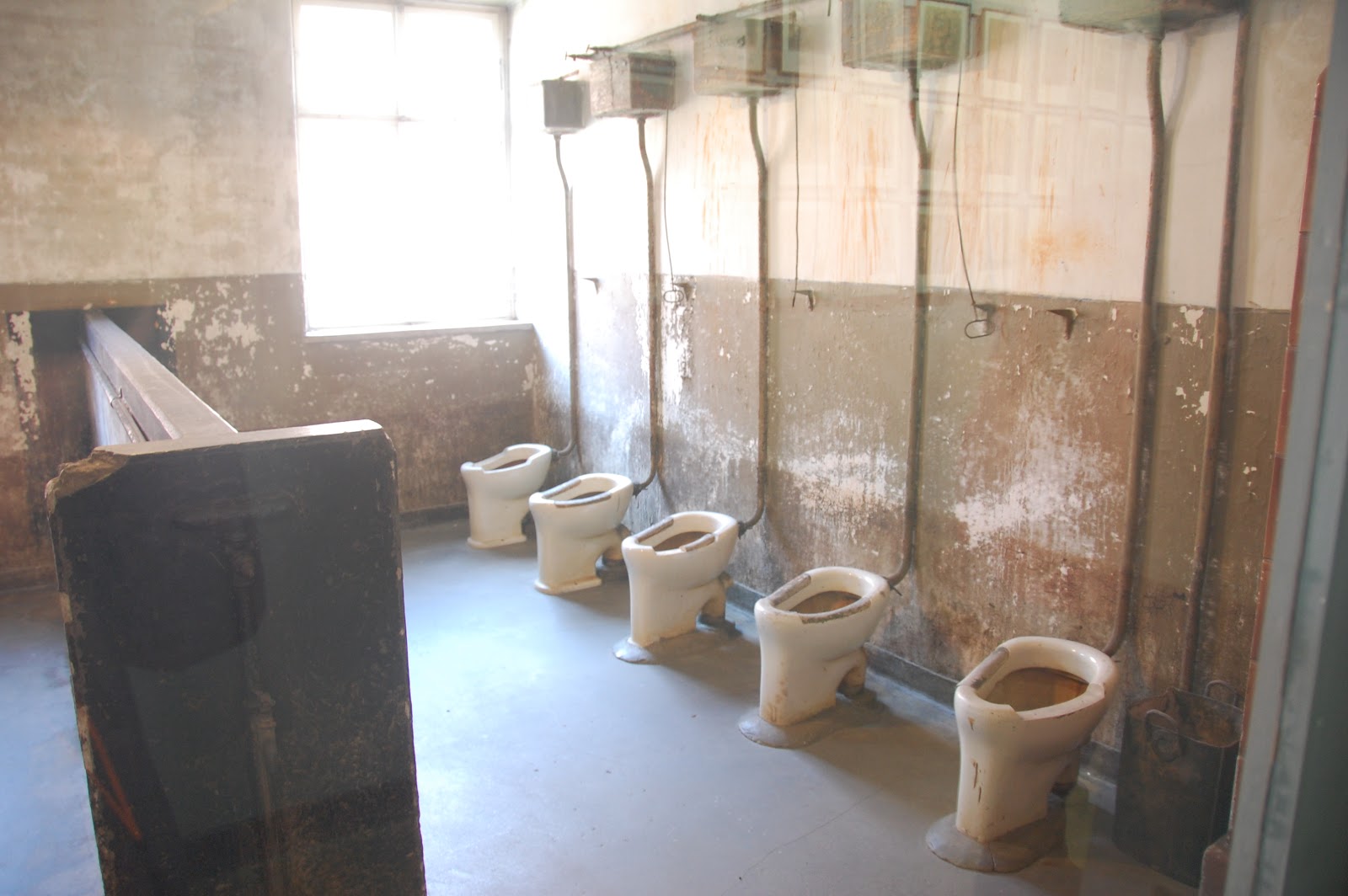
Standard bathroom in the barracks of Auschwitz I.


Sinks/washroom in the barracks of Auschwitz I.  Much of this camp was preserved, unlike other camps you may visit which were leveled except for a few buildings.


The barracks of Auschwitz I all house various exhibits - this one with several large cases filled with leather suitcases and bags that were taken from prisoners as they arrived.  They were told to pack up their belongings for "relocation" from the forced ghettos in their home countries/cities to these new locations.  The Nazis stole all of the personal belongings upon arrival and used them for the war effort when possible.

Shoe collection rivaling that of the Washington DC Holocaust museum.

In this courtyard between Blocks 10 and 11 several thousand prisoners were shot.  In the building to the right many people were put on "trial" (lasting a few minutes) then executed or put into starvation cells or standing cells (no bigger than a phone booth) for hours or days with three other people.

The gas chamber/crematorium at Auschwitz I could kill 700 people at a time.  Soldiers locked the doors on the outside, then dropped pellets of Zyklon B poison gas into the chamber and sealed it off.  It would take 20 minutes to kill everyone and another two days to burn the bodies.  This "inefficiency" led to the construction of Auschwitz II, aka "Birkenau".

Used canisters of Zyklon B.

Pellets of Zyklon B that could be weaponized when heated up past room temperature.

The commander of the camp, Rudolf Hoess, was tried and convicted after the war and sentenced to death.  Survivors asked that the sentence be carried out at the camp, directly between his house and the crematorium.


Entrance and guard tower for Birkenau.  Prisoners rolled right through those gates to the platform that would decide their fate.

On this platform the new arrivals would immediately be sorted into those that should be immediately sent to the gas chambers and those that should be worked to death in the factories.


Prisoners at Birkenau didn't have sturdy brick buildings in which to live.  Rather, they lived in pre-fabricated horse stables with rudimentary bunks like these that they shared with multiple prisoners.  The bedding typically consisted of straw or hay.

Most of the barracks were torn down, but the chimneys remain, giving you an idea of the scale of this camp.  100,000 prisoners could be held here at one time.

This memorial was constructed for the victims of Auschwitz during the Soviet era in 1967 (in the Social Realist style) and is meant to resemble gravestones and a chimney, with plaques in multiple languages along the front summarizing the atrocities committed here.

Memorial plaque in English.

The large-scale gas chambers were dynamited by the Nazis when liberation by the Red Army was eminent.  The ruins were kept as evidence of the mass-murder.

Prisoners were ushered to the end, asked to strip down and were given locker numbers for their personal belongings.  Then they were marched down to the "shower rooms" for "disinfection".  The same technique was used to kill the prisoners as in Auschwitz I.  However, this chamber (in addition to one just like it 100 yards away) allowed for the extermination of 4,400 people per day.  The bodies were quickly cremated and the ashes scattered into a lake.


 Auschwitz was liberated on January 27, 1945 by the Soviets.  7,500 prisoners were rescued, of which about 20% died of disease and/or starvation afterwards.  The Polish government voted to turn this place into a museum so that no one would forget about the events that took place here.

--Justin

Thursday, April 19, 2012

Heading East for Easter: Krakow, Poland - Wieliczka Salt Mines

     When you spend an Easter break in Europe there aren't too many places where you can be guaranteed to have hot, sunny beach weather.  Since that's the case, sometimes you just embrace the fact that it's practically still winter and you'll be packing some sweaters, scarves, gloves, and jackets.  Now that our days are officially numbered in Germany, we've got a short bucket list of places to see while we're still here.  Our two-week Easter break was our last chance to have a lengthy getaway so we chose to check out a strip of "eastern" Europe, beginning in Krakow and heading south through Budapest, Hungary before finishing off with a drive along the Dalmatian Coast in Croatia. (Note:  some would consider this "central" Europe, but it's all relative anyways and besides.........all of these places were formerly behind the "Iron Curtain" so I'll call it eastern Europe, albeit a beginner's version).
     Despite living under an atheistic socialist regime for years, Poland is considered by some to be the most devoutly Catholic country in Europe.  We had heard great things about Krakow and decided to check it out for a few days.  This post focuses on a side trip that we took from Krakow to the nearby Wieliczka ("veel-EECH-kah) salt mine, which initially doesn't sound very cool, but it's actually a very unique site with a long history and a most-impressive interior decor.
     The salt mine has been in use since the 11th century and was the source of great wealth for Poland under king Kazimierz the Great.  The mine is unbelievably vast, including about 2000 large chambers, of which we saw about 20 on our 1.5 hour walking tour (443 feet down).  Walking around and licking walls is one thing, but the real draw to this site is the collection of statues and chapels that have been carved by miners since the 19th century.  Below are some photos of these impressive sculptures...........all entirely made of salt!

As you enter the mine your first task is to descend these steps as far down as you can see, and then some.  Not sure about the exact count, but it was hundreds.

The infrastructure of the mine is all wooden, as metal would corrode in this environment.

Literally all of the walls, ceiling, and floors were entirely lickable.......on second thought that's not so special because technically you could like any wall, ceiling, or floor, but these are all salt (around 95% pure if I remember right).

We were also encouraged to pluck salt crystals off of low-hanging ceilings to taste.  The test came back positive - it's salt!  Here I was contemplating how much better it would be if this were a sugar mine.

The first work that you come across is this sculpture of Nicolaus Copernicus (Mikolaj Kopernik in Polish, his home country).  This is the only work done by an artist from outside the mine.  He is beloved by his countrymen and is most famous for formulating the heliocentric theory - that the Earth revolves around the Sun, not vice versa.  He actually visited this mine in the 15th century.

So three miners spent the majority of their careers in the mine carving out chapels and adorning them with sculptures (mostly religious) and chandeliers such as this one.

St. Jadwiga (on left) was "king" of Poland succeeded Kazimierz the Great at the end of the 14th century and his regarded as a hero because she married a Lithuanian Prince Jagiello, thus uniting the two kingdoms against the Teutonic Knights (German crusaders basically).  She Christianized Lithuania, kicked off the Jagiellonian dynasty in Poland and was actually sainted by John Paul II in 1997.

The main attraction is this Chapel of St. Kinga.  It was carved in the early 20th century and is loaded with impressive Christian reliefs and sculptures.

John Paul II - probably the most beloved native of this devoutly Catholic nation.

Relief in the Chapel of St. Kinga - keep in mind that these were just talented miners who acted on a hobby, not Renaissance artists.

The Last Supper relief is one of the focus pieces here.

As you can see, this is not your stereotypical salt mine.  I definitely recommend stopping by this one-of-a-kind place if you find yourself in Krakow.  Let me know if you come across a sugar mine.

--Justin
Related Posts Plugin for WordPress, Blogger...