Home

Wednesday, April 10, 2013

Good Morning Vietnam 2013: Cu Chi Tunnels and more

     One of our day trips from Ho Chi Minh City was to see the Cu Chi Tunnels which were used in the Vietnam War by the Viet Cong in their resistance against the U.S. troops in South Vietnam.  Many of the fighters were farmers by day and soldiers by night, using guerrilla tactics to hold off the Americans while being grossly under-equipped in comparison.  We gained some insight into the resourcefulness of the people and their determination to fight for their cause.

On the way to the Cu Chi Tunnels we passed by many rubber tree plantations.  They were lined up about as perfect as it can get.

Once at the tunnels there were exhibits on many of the booby trap defenses that were used against U.S. troops.  Many resembled hunting traps, such as this pit of bamboo spikes.  Oftentimes the tips would be coated with poison.

This crater was made by the B-52 bombers.

Since U.S. troops were all over the area, the entrances to the tunnels had to be carefully concealed, like this one in front of the tree.  Our guide Hai will now demonstrate the method of entry...

First, you find the edges of the cover.

Then, remove the cover.

Lower body in feet first.

Grab cover and lower the rest of the body down while holding cover above the head.  Now you see him...

...now you don't!

There were also demonstrations of the resourcefulness of the Viet Cong - such as this fella using old tires to make rubber sandals.

Here's another entrance to the tunnels via a fighting ditch.

I'm standing in another crater made by the B-52 bombers.

Marisa and I gave the tunnels a shot and while she's smiling in this photo, she was anything but a happy customer in the tight, stuffy space.  We only went 50 yards or so, but that was enough for her.

I went with our guide for another 100 yards or so and trust me that it was not the place for anybody with claustrophobia.  I can't imagine spending hours hiding in and basically living in these tunnels.

Needless to say I was a sweaty fool after that trek.

The rooms that were made for cooking had carefully concealed vents.

     Our last stop was to visit a Cao Dai temple for a weekly ceremony.  If you haven't heard of Caodaiism then you're probably not alone, as this religion was established in 1926 and only has a few million followers. 

I can't say what really went on during the service, besides a bunch of these jokers in white robes (men and women) meditating and bowing in sync to some live music going on in the upper balcony.


This guy seemed special since he sat all the way in front and got to wear the fancy outfit.  Nothing was really said and no one really got up and faced the crowd, read anything, led any singing - they just went through cycles of staring forward followed by bowing down.

The house band

The Cao Dai temple from the outside.

I believe the eye represents God in their system.

Photo-op after lunch - which just may've been the culprit in our food poisoning scandal.

Our tour guide Hai for Ho Chi Minh City and the Mekong Delta was a breath of fresh air compared to our previous guides in Hue and Hoi An.  We learned a ton from this guy.

--Justin

Good Morning Vietnam 2013: Mekong Delta

From Ho Chi Minh city we took a day trip to the Mekong Delta region. This was one of my favorite places in south Vietnam. It provided a small glimpse into the lives of the families that live and thrive off the river. Before hitting the river we did stop at a temple to check out some large Buddha statues. 

I just liked this picture

A quick stop to see some giant Buddhas 


Nothing says worship like some neon lights


Heading out on the Mekong River with my new hat

These are the motorized boats that go up and down the river

First stop a coconut candy making place. The Mekong Delta is saturated with coconut trees and this is just one of the ways they try to make some revenue with the natural resource. 


A more typical way of transportation

A fruit and tea break...you know I was loving this

The unmotorized boats and the more common way of transportation for the locals

Cruising down the river

We stop to have lunch at a big island/park on the river and they had a huge cage of crocodiles  It did make me kind of sad because people had thrown trash in the cage and it looked so dirty

A fruit I have never seen and still don't know what it is. Anyone?

We finished by having some river fish and watching some foreigners drink snake blood. It was crazy the snake came out alive and the chef straighten it out and cut it's throat and drained it into a cup. Just writing that made me gag a bit...GROSS. 

If you are down in the capital city of Ho Chi Minh city, a day-trip to experience the Mekong Delta is a must. Beautiful landscape, but also a trip back in time.

--Marisa

Tuesday, April 9, 2013

Good Morning Vietnam 2013: Ho Chi Minh City

     That last big stop on our tour was Ho Chi Minh City - formerly known, and still known to many, as Saigon.  As the former capital of South Vietnam, it's got a lot of things that a typical capital city would have such as a palace, post office, cathedral, a palace, and plenty of statues of Uncle Ho (added after the war of course).  For this post, I'll focus on the most impactful site for me - the War Remnants Museum.

     If you're visiting Saigon, you must visit this museum.  The overall aim is to bring the atrocities of war to light and to deter future generations from engaging in similar conflicts.  It's a multi-level building with a collection of military vehicles outside, an exhibit on the torture camps for POWs in South Vietnam, a photo exhibit on civilian massacres, photos of soldiers and the effects of Agent Orange, an exhibit on the worldwide protests against the war, and a special (and perhaps rotating) exhibit that was on the life of school children during the war.

Flamethrower used to decimate foliage.

Not sure what type of tank we've got here.

Sign on the outside of the museum.

American fighter planes.

"Tiger Cages" were used in the POW camps by the South Vietnamese as a form of torture to get information.  Prisoners were held in these naked and exposed to the sun.

Photo of "Uncle Ho" visiting a school with children that have entirely too much make-up on.

Statement from the North Vietnamese voicing their thanks for support from other countries for their cause.

German posters voicing support for North Vietnam.

Posted casualties.

     While photography was permitted in all parts of the museum, I really couldn't bring myself to take any photos from the other exhibits.  After visiting three different concentration camps in Germany/Poland and hearing the horrible stories of torture and execution during WWII, I found that the graphic pictures in this museum made a much stronger impact on me.  Due to the time period of the conflict, this war was far more documented in pictures than WWII and this museum held nothing back.  It was a little awkward walking through the museum as an American and knowing that most of this damage and destruction came from our troops, but at the same time I didn't feel like the museum was putting all of the blame on Americans either.  They presented it as a very unpopular war that was perpetuated by a handful of politicians.  From talking to our tour guide who is of a similar age, he felt like this generation is ready to move on and doesn't really hold a grudge against the USA.  That was certainly a relief.

We also got to tour the inside of the "Reunification Palace" that was the former residence of the President of South Vietnam.


These two tanks were the first North Vietnamese vehicles to crash through the front gate and stake claim to the presidential palace after the president escaped via helicopter.


Much of the basement area of the palace was filled with old communications equipment supplied by the USA.  It was kind of a museum with old rotary phones, radio equipment, and classic fake wood paneling.

Of course the basement also included these bomb-shelter corridors with thick concrete walls as you can see.
Here's the South Vietnamese flag that was taken down from atop the presidential palace.

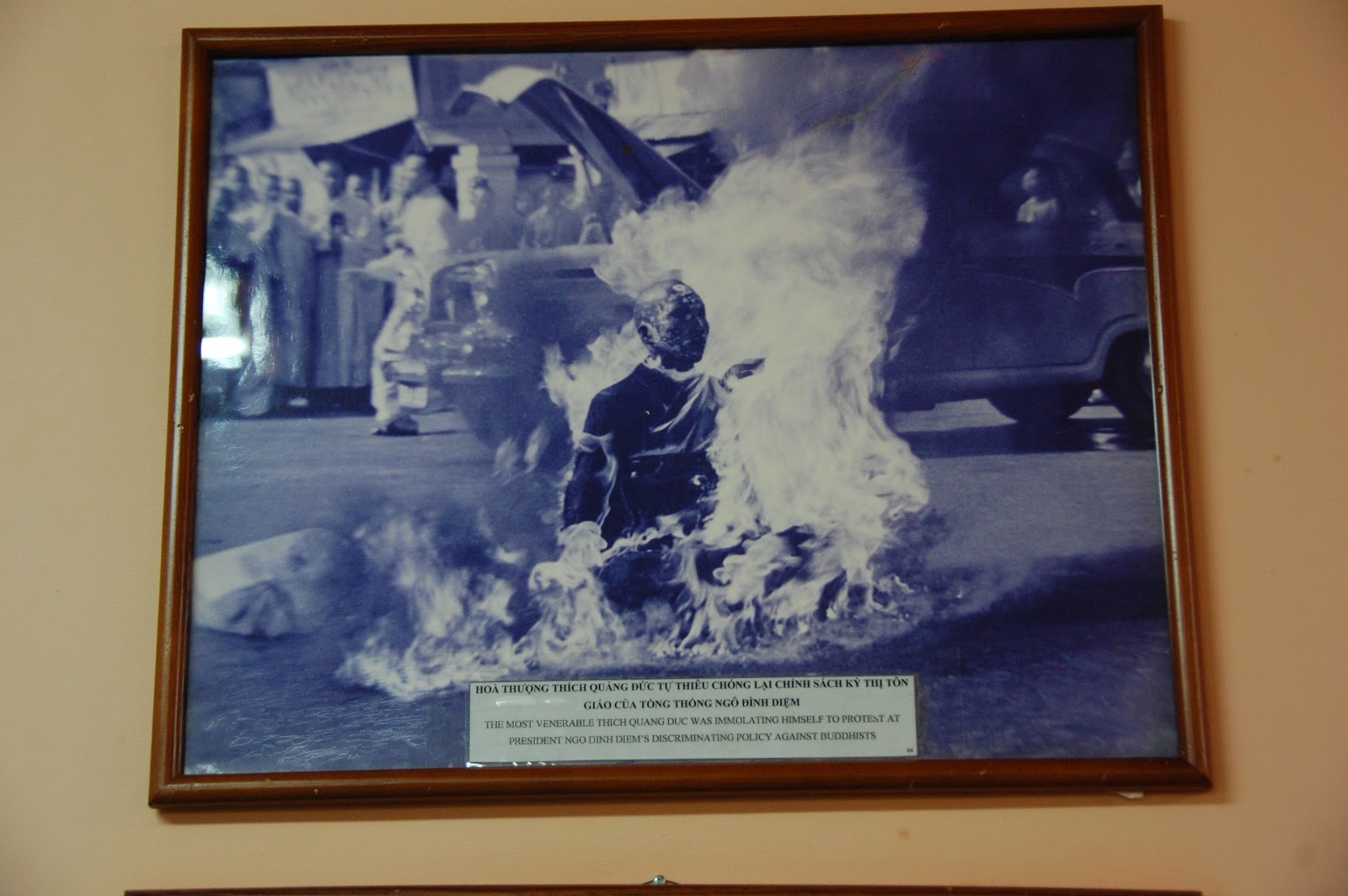
Perhaps you recognize this image from the cover of a Rage Against the Machine album or from the previous post on Hue and Hoi An.  This is the monk that set himself on fire ("self immolation") in protest of the South Vietnamese leader's persecution of the Buddhist religion.  The car that he used to get to Saigon is shown in the background - the same one seen in the previous post.  I cannot imagine the courage it would take to make that sacrifice. 

View of the Reunification Palace with the current flag mounted atop. 

The old post office that resembles European train stations - even on the inside.
I told you so.  These folks may look like they're waiting for a train, but they're really just figuring out how many stamps they want to buy.......all while Uncle Ho looks over them.
 
St. Patrick's Cathedral - just next to the post office.
I want to say that this is some sort of a City Hall that looked very nicely lit in the evenings.

Uncle Ho Chi Minh - again with a child on his lap, which seems to be a theme for this guy.

The scooter traffic in Hanoi was impressive, but everyone agrees that Ho Chi Minh city takes the prize!

     Saigon should be on your itinerary when visiting Vietnam.  It's a bit livelier in the evenings than Hanoi and it feels bigger and more modern in comparison.  The War Remnants Museum can't be missed and it serves as a nice launching point for day trips into the Mekong Delta.

--Justin
Related Posts Plugin for WordPress, Blogger...